Learn the Science
The gut microbiome has become one of the most talked-about areas of weight research. That raises a practical question: Can changing the bacteria and other microorganisms living in your gut actually help with weight management?
The answer is more complicated than many headlines suggest. Diet can influence the gut microbiome, and the microbiome is connected with metabolic health. But scientists have not identified one universal “weight-loss microbiome” that everyone should try to restore.
What Is the Gut Microbiome?
Your digestive tract contains a vast community of microorganisms. Collectively, this ecosystem is commonly called the gut microbiome.
These organisms interact with the foods we eat and produce compounds that can affect processes throughout the body. Researchers are studying their connections with metabolism, inflammation, glucose regulation, appetite, and obesity.
That does not mean researchers have discovered a simple bacterial switch for weight loss.
Studies comparing people with and without obesity have reported differences in gut microbial communities, but the findings are not consistent enough to define one microbiome as the universal “obesity microbiome” or another as the ideal “lean microbiome.” People differ substantially, and diet, medications, geography, physical activity, health conditions, and many other factors can influence microbial composition.
So Can You “Restore” Your Microbiome for Weight Loss?
Not in the precise way that phrase implies.
Scientists can measure changes in gut microorganisms after dietary or weight-loss interventions. However, those microbial changes do not always track directly with the amount of weight a person loses.
This distinction matters. A food can support gut health without being a weight-loss treatment. Likewise, a change in a particular bacterial population does not automatically mean that the change will cause someone to lose weight.
At Obesity Zero Center, we think the practical question is more useful when stated this way: What habits have reasonable evidence for supporting the gut microbiome while also fitting into an overall approach to metabolic health?
1. Give Gut Microbes a Variety of Plant Fibers
This is one of the stronger parts of the microbiome story.
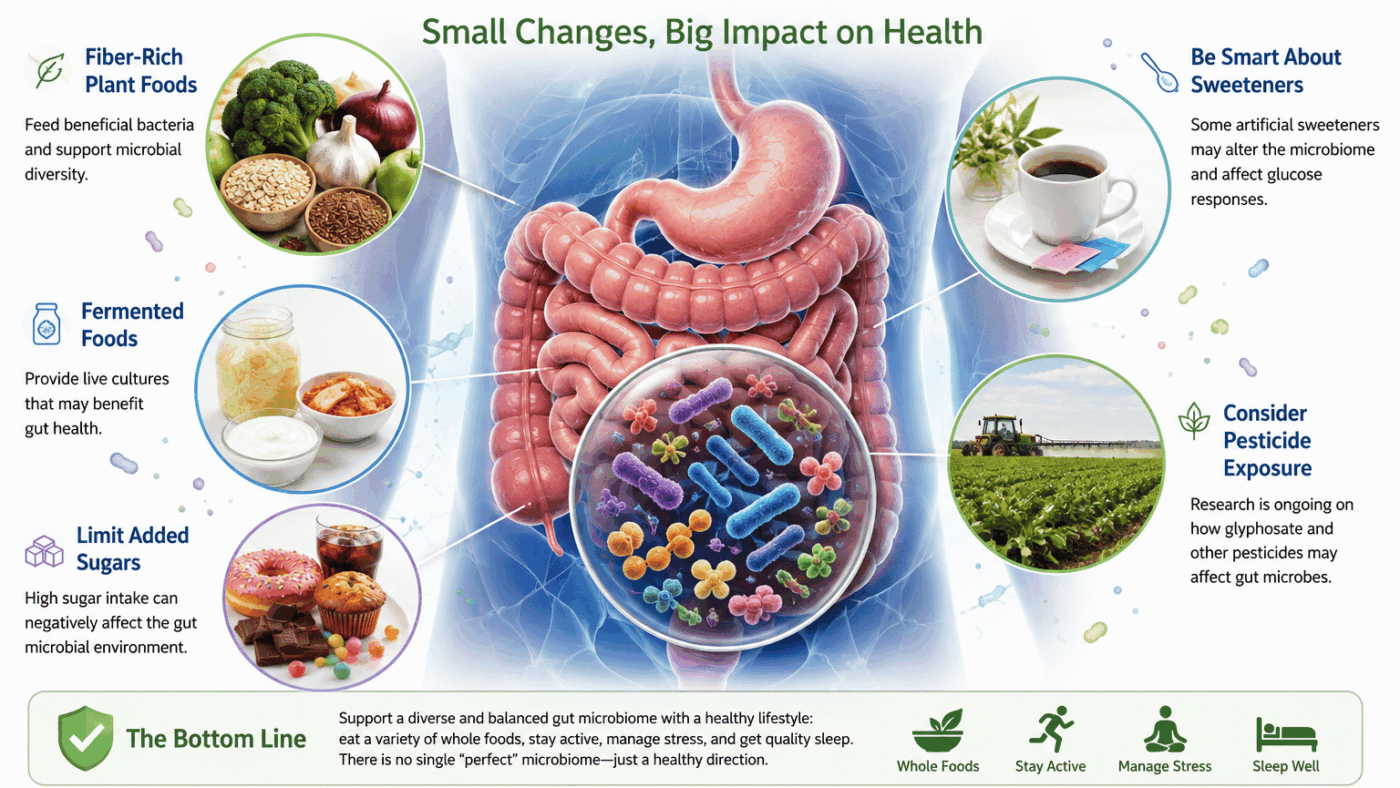
Many dietary fibers reach the large intestine, where gut microorganisms can ferment them. Different fibers can support different organisms and microbial functions, which is one reason dietary variety matters.
Depending on your preferences and tolerance, fiber-containing foods can include:
- Oats and other whole grains
- Beans, lentils, and peas
- Vegetables
- Fruit
- Nuts and seeds
- Onions and garlic
- Flaxseed
Specific prebiotic fibers have increased populations of bacteria such as Bifidobacterium in human studies. But this does not mean everyone needs to target one bacterial species or buy a specialized microbiome product.
For most people, the more practical starting point is a varied diet containing fiber-rich plant foods that they can tolerate and sustain.
2. Put Added Sugar and Sweeteners in Perspective
Timothy raised two separate issues here: refined or added sugars and non-nutritive sweeteners. They should not be treated as the same thing.
Added sugars
High added-sugar intake is already worth limiting for established nutritional and metabolic reasons. Researchers are also investigating whether part of its effect on health involves the gut microbiome.
Recent research reviews suggest that high added-sugar intake can alter microbial composition and function. However, results differ among studies. The science is more complicated than saying sugar simply “feeds bad bacteria.”
Non-nutritive sweeteners
A well-known randomized human study found that several non-nutritive sweeteners produced distinct changes in participants’ microbiomes. In that study, saccharin and sucralose were also associated with impaired glycemic responses in the groups receiving them.
That finding deserves attention, but it does not prove that every non-nutritive sweetener harms every person’s microbiome or causes weight gain. Responses varied among individuals, the intervention was short, and researchers noted that the long-term clinical implications require further study.
3. Consider Fermented Foods
Foods such as yogurt or kefir with live cultures, kimchi, and some unpasteurized fermented vegetables can contain living microorganisms. The exact organisms and amounts vary greatly by product and processing method.
In a randomized study of healthy adults, researchers compared diets high in fiber with diets high in fermented foods. The fermented-food group showed an increase in microbiome diversity and decreases in several inflammatory markers.
That is interesting evidence, but there is an important limitation: the study does not establish fermented foods as a weight-loss treatment.
Fermented foods can instead be viewed as one possible component of a varied diet. Choose options that fit your overall nutritional needs, particularly since products can vary considerably in added sugar, sodium, calories, and alcohol content.
4. What About Pesticides and Glyphosate?
This is an area where it is especially important to separate a plausible biological question from an established human-health conclusion.
Glyphosate affects a biochemical pathway used by plants and many microorganisms. This has led researchers to investigate whether glyphosate exposure could also influence microorganisms in the digestive tract.
Laboratory and animal research gives scientists reasons to continue studying that question. However, the available evidence does not establish that ordinary dietary glyphosate exposure acts as a “synthetic antibiotic” that destroys beneficial human gut bacteria or causes obesity.
Current U.S. regulatory assessments also do not conclude that permitted dietary glyphosate residues pose a demonstrated human health risk. The Environmental Protection Agency is continuing to update its assessment as newer evidence becomes available.
People may choose organic foods for many personal reasons, but we do not currently have sufficient evidence to tell readers that switching to organic or regenerative produce is necessary to restore the gut microbiome or lose weight.
The Bigger Picture: Support Health, Not a “Perfect” Microbiome
The microbiome is an exciting part of obesity science precisely because researchers still have so much to learn.
We know that diet can change microbial activity and, in some cases, microbial composition. We also know that obesity is associated with microbiome differences in some studies. What we do not yet know is how to turn those observations into one microbiome formula that reliably produces weight loss across different people.
That is why the most defensible practical approach is also the least sensational:
- Eat a varied selection of fiber-rich plant foods that work for you.
- Limit excessive added sugars as part of an overall nutritious eating pattern.
- Consider fermented foods if you enjoy and tolerate them.
- Do not assume one bacterium, supplement, food, or microbiome test holds the key to weight loss.
- Be cautious when preliminary microbiome research is turned into a guaranteed health claim.
Conclusion
Can you influence your gut microbiome? Yes. Diet is one of several factors that can shape it.
Can scientists currently tell you exactly how to “restore” it for weight loss? No.
The evidence supports a more measured strategy: build a varied, fiber-rich eating pattern, consider fermented foods, keep added sugars in perspective, and remain skeptical of claims that promise to engineer the perfect gut microbiome.
As microbiome research advances, we may eventually understand much more about which changes matter for specific people. For now, the best approach is to use this emerging science as one piece of the larger weight-management picture, not as a shortcut around it.
Sources and Further Reading
- Pinart M, et al. Gut Microbiome Composition in Obese and Non-Obese Persons: A Systematic Review and Meta-Analysis. Nutrients. 2021.
- Delzenne NM, et al. The gut microbiome and dietary fibres: implications in obesity, cardiometabolic diseases and cancer. Nature Reviews Microbiology. 2025.
- Wastyk HC, et al. Gut-microbiota-targeted diets modulate human immune status. Cell. 2021.
- Suez J, et al. Personalized microbiome-driven effects of non-nutritive sweeteners on human glucose tolerance. Cell. 2022.
- U.S. Environmental Protection Agency. Glyphosate.
- U.S. Food and Drug Administration. Questions and Answers on Glyphosate.