
Learn the Science

Why Understanding Adipose Tissue Matters

Learn the Science

Understanding body fat means looking beyond the number on a scale. Adipose tissue is biologically active, and where fat is stored can contribute to health risk.

For a long time, body fat was often described as if it were one uniform substance: something the body simply stores when energy intake exceeds energy use.

Modern biology tells a more complicated story.

Body fat, known medically as adipose tissue, is biologically active. It stores energy, but it also participates in metabolic, hormonal, and immune signaling. Its behavior can be influenced by genetics, physiology, environment, health conditions, medications, and other factors.

For people living with obesity, understanding this biology can help shift the conversation away from blame and toward a more accurate question: What is happening inside the body, and what information can help us better understand health?

What Is Adiposity?

Adiposity refers broadly to the amount and distribution of body fat in the body.

A standard scale measures total body weight. It cannot distinguish how much of that weight comes from fat, muscle, bone, organs, or body water. Body mass index, or BMI, is also a screening measurement rather than a direct measurement of body fat or fat distribution.

Other tools can provide additional information. Depending on the situation, health professionals may consider waist circumference, waist-to-height ratio, body-composition measurements, blood pressure, glucose, lipids, medical history, and other clinical information.

What the Research Shows

No single measurement tells the entire story. A person’s scale weight, BMI, body-fat percentage, waist size, and laboratory results can each provide different pieces of information.

Adiposity Is Not a Simple Measure of Willpower

Obesity is a complex chronic disease. Its development can involve genetics, neurobiology, physiology, eating patterns, physical activity, stress, sleep, medications, health conditions, and environmental influences.

That does not mean daily habits are unimportant. It means obesity cannot be accurately explained as a simple lack of discipline or willpower.

Understanding the biology does not take away personal agency. Instead, it can help replace shame and oversimplification with better information and more realistic decisions.

Where Body Fat Is Stored Can Matter

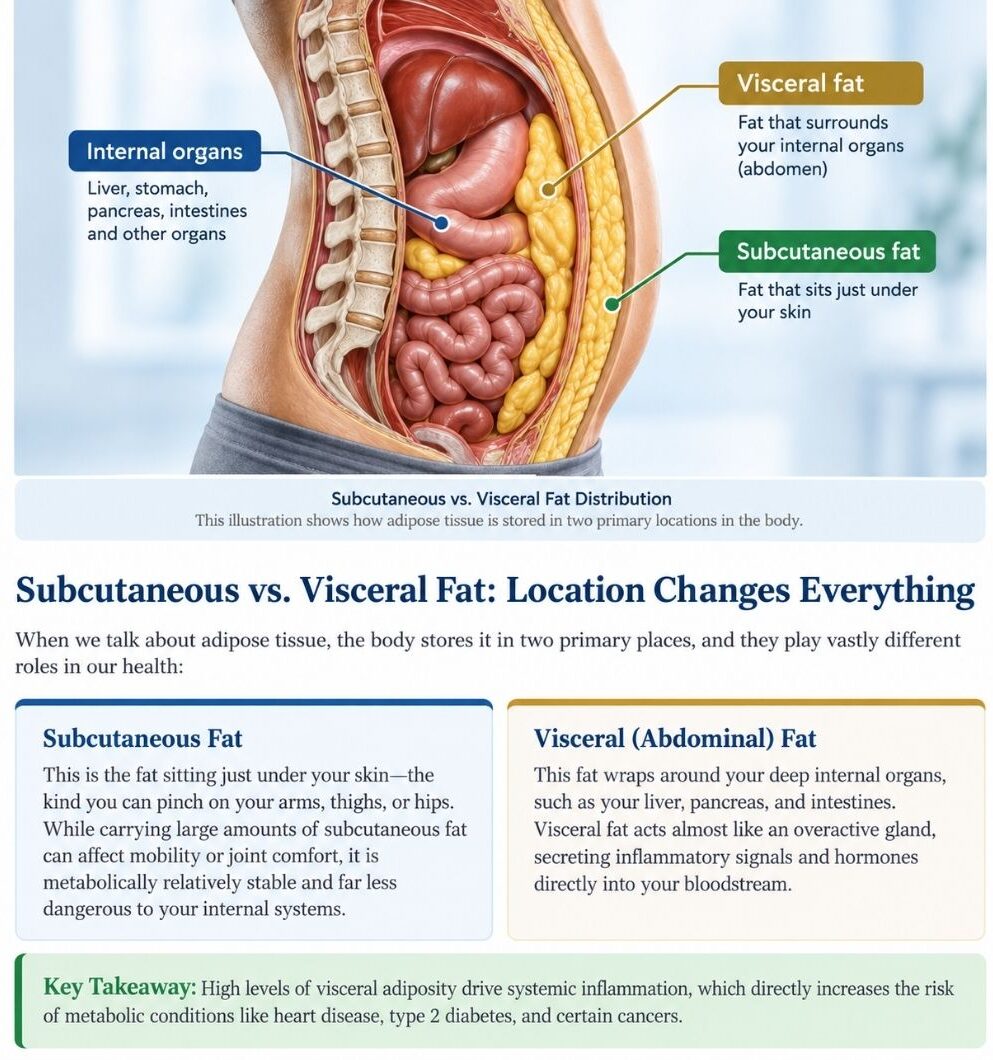
There are many adipose tissue depots throughout the body. Two major types often discussed in relation to abdominal fat are subcutaneous fat and visceral fat.

Subcutaneous Fat

Subcutaneous fat is stored beneath the skin. It is the fat that can often be pinched in areas such as the arms, thighs, hips, and abdomen.

Subcutaneous fat is not simply “good” or biologically inactive. It is an important part of normal physiology. However, in general, visceral fat is more strongly associated with cardiometabolic risk than subcutaneous fat.

Visceral Fat

Visceral fat is stored deeper within the abdominal cavity around internal organs.

Visceral adipose tissue is metabolically active and is associated with changes in inflammatory and metabolic signaling. Higher levels of visceral adiposity are also associated with greater risk of metabolic syndrome and related cardiometabolic conditions.

Important Distinction

It is not scientifically accurate to divide all body fat into “harmless fat” and “dangerous fat.” Health risk depends on the amount, location, function, and distribution of adipose tissue, along with many other individual factors.

Why Visceral Adiposity Gets So Much Attention

Excess fat around the abdomen is associated with increased risk for several health problems. That is why waist circumference can provide useful information that a scale alone cannot provide.

Higher levels of visceral adiposity have been linked with adverse metabolic changes and increased risk of conditions such as type 2 diabetes and cardiovascular disease. Excess body fat is also associated with increased risk for some cancers.

These relationships are important, but they should not be oversimplified. A person’s health cannot be determined by one body measurement or by assuming that everyone with the same amount of abdominal fat has the same risk.

Why Scale Weight Does Not Tell the Whole Story

Imagine two people who weigh the same amount. Their bodies may still differ substantially.

One person may have more lean mass. Another may carry a greater proportion of body fat around the abdomen. Their medical histories, blood pressure, glucose levels, lipids, physical fitness, and other health factors may also be different.

That is why a number on the scale can be useful without being the entire picture.

  • Body weight shows total mass.
  • BMI provides a screening estimate based on weight and height.
  • Waist circumference can provide information about abdominal fat distribution.
  • Body-composition testing can estimate fat and lean tissue using methods such as DXA or other clinical tools.
  • Health markers such as blood pressure, glucose, and lipids can provide additional information about cardiometabolic health.
The Better Question

Instead of asking only, “What do I weigh?” it can sometimes be more useful to ask, “What information gives me the clearest picture of my health and what changes are most likely to help?”

Can You Change Where Your Body Loses Fat?

You cannot reliably choose one area of the body and force it to lose fat first. There is no exercise, food, or supplement that selectively removes fat from one body location.

However, research suggests that during weight loss, visceral fat may decline proportionally more than subcutaneous fat, particularly with modest weight loss. The exact pattern varies between individuals.

Regular exercise can also help reduce visceral adipose tissue. Research has found benefits from several forms of exercise, including aerobic exercise, resistance training, combined exercise, and interval training.

Why Understanding Adipose Tissue Can Change the Narrative

1. It Can Help Remove Shame

Understanding that obesity involves complex biological and environmental factors can challenge the harmful idea that body size is simply a visible measure of effort or character.

People can make meaningful changes while also recognizing that the body is responding to a complicated biological system.

2. It Helps Explain Why the Scale Is Only One Tool

A scale can be useful for tracking total weight, but it cannot show where body fat is stored or distinguish fat from lean tissue.

For some people, other measurements can provide important context.

3. It Encourages a More Complete View of Health

Depending on an individual’s circumstances, health professionals may look at waist measurements, blood pressure, glucose, lipids, body composition, symptoms, mobility, medical history, and other factors.

This broader approach can help move the conversation beyond one number and toward a fuller understanding of health.

Science Before Simplistic Answers

Learning about adipose tissue does not mean every question about obesity has an easy answer. The science of body fat, metabolism, genetics, appetite, and weight regulation is complex.

But one thing is clear: body fat is not a passive passenger, and obesity is not accurately explained by willpower alone.

Understanding the biology can help people ask better questions, recognize hype, discuss health concerns more productively, and explore evidence-based options with qualified health professionals when appropriate.

The Bottom Line

Adipose tissue is an active and important part of human biology.

Its amount, distribution, and function can matter. Visceral adiposity deserves particular attention because of its stronger association with cardiometabolic risk, but no single measurement or type of body fat tells the entire story.

Understanding adipose tissue can help us move beyond simplistic ideas about “weight” and toward a more complete, evidence-based understanding of obesity and health.

Sources and Further Reading

  1. Centers for Disease Control and Prevention. About Body Mass Index (BMI).
  2. Centers for Disease Control and Prevention. Consequences of Obesity.
  3. National Institute of Diabetes and Digestive and Kidney Diseases. Am I at a Healthy Weight?
  4. National Institute of Diabetes and Digestive and Kidney Diseases. Health Risks of Overweight and Obesity.
  5. Screening, Diagnosis, Evaluation, and Staging of Obesity in Adults: Standards of Care in Overweight and Obesity, 2026.
  6. Bennett JP, Prado CM, Heymsfield SB, Shepherd JA. Evaluation of visceral adipose tissue thresholds for elevated metabolic syndrome risk across diverse populations: A systematic review. Obesity Reviews. 2024.
  7. Chen X, He H, Xie K, Zhang L, Cao C. Effects of various exercise types on visceral adipose tissue in individuals with overweight and obesity: A systematic review and network meta-analysis of 84 randomized controlled trials. Obesity Reviews. 2024.
  8. Recchia F, Leung CK, Yu AP, et al. Dose-response effects of exercise and caloric restriction on visceral adiposity in overweight and obese adults: A systematic review and meta-analysis of randomized controlled trials. British Journal of Sports Medicine. 2023.
  9. Chaston TB, Dixon JB. Factors associated with percent change in visceral versus subcutaneous abdominal fat during weight loss: Findings from a systematic review.
  10. Kershaw EE, Flier JS. Adipose tissue as an endocrine organ. Journal of Clinical Endocrinology and Metabolism.