
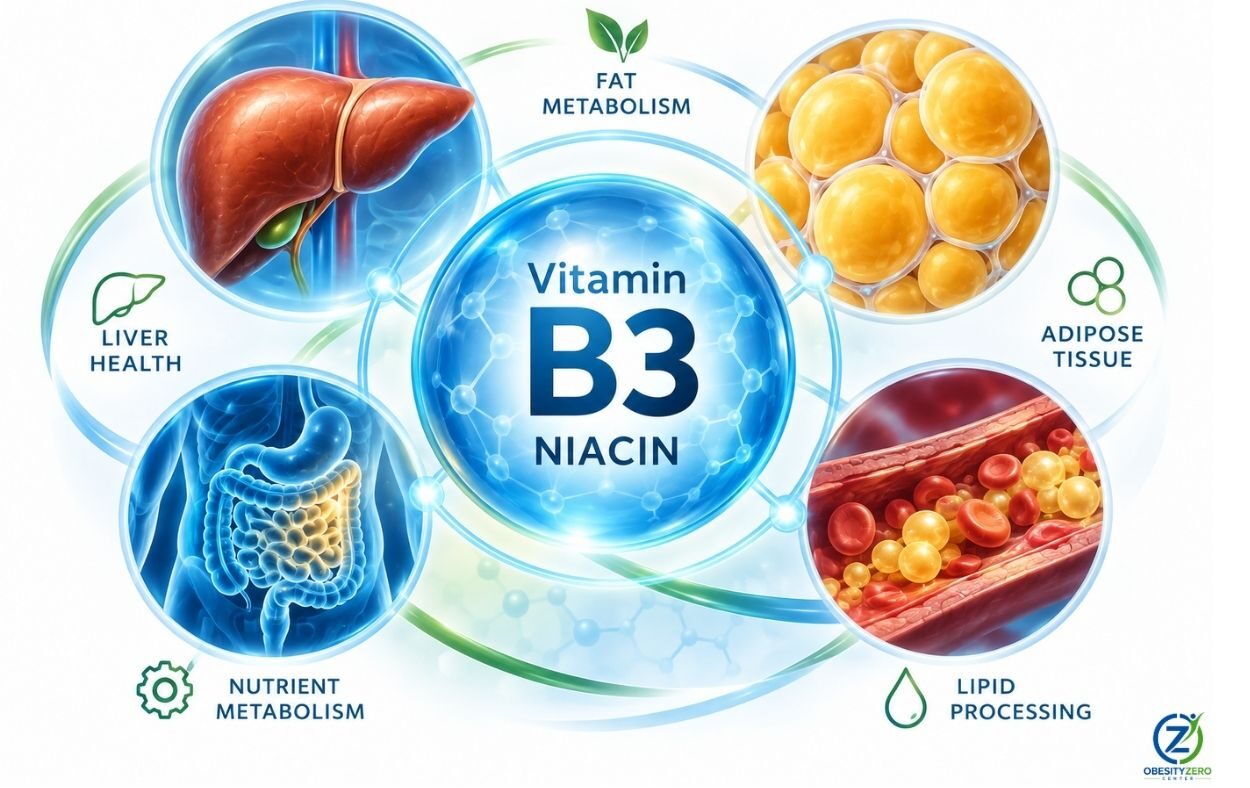
Our goal at Obesity Zero Center is to pass along the real, accessible science that empowers us to conquer the global obesity crisis in a natural, sustainable way, focusing on lifestyle, behavior, and true health rather than billable medical products.
Vitamin B3, commonly known as Niacin and its “no-flush” counterpart, Niacinamide, holds a unique title: it is the only essential vitamin your body can actually manufacture on its own.
Synthesized from the amino acid tryptophan, your body values B3 so much that under severe deficiency conditions, it will aggressively redirect tryptophan away from creating serotonin (the brain’s feel-good chemical) just to keep your niacin levels afloat.
While a full deficiency leads to the rare but dangerous disease pellagra (traditionally marked by the “4 D’s”: diarrhea, dermatitis, dementia, and death), many people today likely suffer from unrecognized, sub-acute shortages that show up as chronic digestive sluggishness, stubborn skin rashes, and brain fog.
Beyond its well-documented benefits for mental health, insomnia, and topical skincare, recent attention has centered heavily on how Vitamin B3 interacts with body fat.
Direct Impact on Obesity and Fat Deposits
Niacin does far more than just keep you healthy. It actively alters how your body processes, stores, and breaks down fat molecules.
Reversing Fatty Liver Disease & Lipomas
Vitamin B3 exhibits a powerful ability to mobilize and target deep fat deposits. Clinical insights suggest that targeted niacin supplementation can be highly valuable for patients dealing with fatty liver disease, where dangerous fat accumulates inside organ tissue. Furthermore, it has been used to help manage lipomas (benign, localized lumps of fat cells under the skin) and general obesity by altering fat transport signals.
Clearing Inflammatory Blood Fats
Niacin functions as a heavy-hitting metabolic regulator. It directly limits the flux of free fatty acids traveling from your fat tissue to your liver, which in turn reduces hepatic triglyceride production. By cleaning up these inflammatory, circulating blood fats, niacin prevents them from clogging arteries and exacerbating heart disease.
Activating Metabolic Regulators
Recent research shows that pharmacological doses of niacin help mitigate the damage of high-fat diets by stimulating adiponectin. Adiponectin is a crucial anti-inflammatory hormone secreted by your fat tissue that naturally plummets when a person develops obesity. By boosting this hormone, niacin helps protect the body from obesity-induced tissue inflammation and improves overall insulin sensitivity.
Secondary Benefits: From Brain Health to Skincare
While its fat-burning and artery-clearing properties take center stage, Vitamin B3 remains a versatile multi-tasker:
- Psychological Support: Niacin has a long history of use in orthomolecular medicine to treat schizophrenia, deep anxiety, and severe depression.
- Nicotine De-addiction: Because nicotine and niacin share similar biochemical pathways, some researchers believe that heavy smoking and nicotine addiction are actually misguided, self-medicating attempts to soothe an underlying Vitamin B3 deficiency.
- Topical Skin Rescue: When applied directly to the skin, both niacin and niacinamide work wonders to regulate sebum (oil production), clear up acne blemishes, and fade dark spots.