
Learn the Science
Five evidence-informed habits that support sustainable progress without quick-fix promises.
Belly fat attracts some of the boldest promises in the weight-loss marketplace. Pills, powders, restrictive plans, and specialized workouts may claim to flatten the stomach quickly. The appeal is understandable, especially when someone has worked hard without seeing the change they hoped for.
The honest answer is less dramatic, but more useful. No single food, supplement, or exercise can be relied upon to selectively remove fat from the belly. Sustainable progress usually comes from a broader plan that a person can follow consistently, with adjustments for health, ability, medications, environment, and other factors that affect weight.
Why Belly Fat Deserves Attention
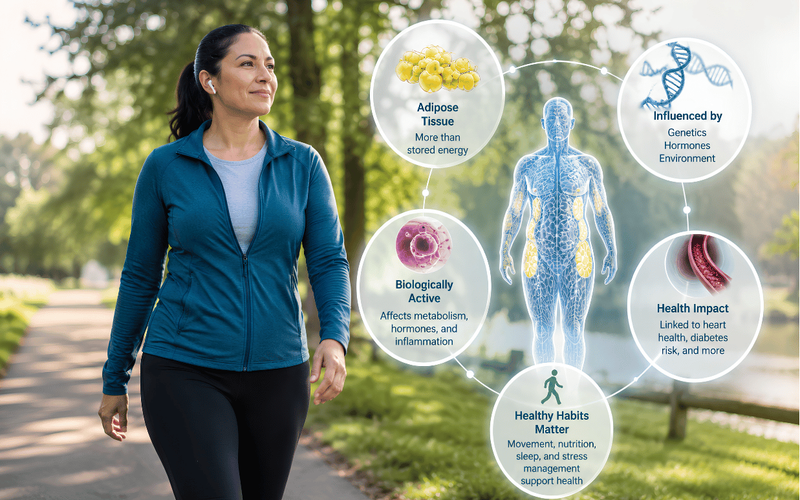
Body fat is not stored in the same way or in the same places for everyone. Fat around the abdomen can include fat beneath the skin and visceral fat stored deeper around internal organs. The National Institute of Diabetes and Digestive and Kidney Diseases explains that waist size and fat stored around the abdomen can help indicate weight-related health risk.
This does not mean that appearance alone tells the full story of someone’s health. It means that excess waist size may be one useful reason to talk with a qualified health professional about overall health, risk factors, and realistic goals.
First, Reject the Quick-Fix Mindset
Be skeptical of any product that promises to melt, target, or eliminate belly fat with little effort. Weight is affected by many factors, including eating patterns, activity, sleep, stress, medicines, medical conditions, genetics, age, environment, and access to supportive resources. Reducing a complex health issue to one ingredient or one trick is rarely honest.
There is also an important distinction between unproven “miracle” products and evidence-based medical treatment. According to the NIDDK overview of overweight and obesity treatment, lifestyle support is often part of care, while prescription medication or metabolic and bariatric surgery may also be appropriate for some people. Those options require individualized evaluation by qualified health professionals.
Five Habits That Support Sustainable Progress
1. Make Sleep Part of the Plan
Sleep is not a passive extra. The NIDDK reports that inadequate sleep is linked with weight gain and may leave people hungrier, consuming more calories, and more likely to choose less nutritious foods and drinks. Sleep can also affect energy and a person’s ability to follow through with planned meals or physical activity.
The science is more complicated than saying that one hormone directly creates belly fat. A more accurate conclusion is that sleep is one meaningful part of weight regulation. If loud snoring, gasping during sleep, severe daytime sleepiness, or persistent insomnia is present, professional evaluation may be important.
Practical step: Keep a regular sleep and wake schedule when possible, reduce late-night distractions, and include sleep in the same weekly tracking system used for food and activity.
2. Choose Water, Especially in Place of Sugary Drinks
Water helps the body function normally and prevents dehydration. It does not directly burn belly fat. Its clearest weight-management advantage comes when it replaces a drink that contains added sugar and calories. The CDC notes that replacing sugary drinks with plain water can help reduce calorie intake.
There is no universal water target that fits every person. Needs vary with age, activity, climate, pregnancy, and health. People who have been told to limit fluids because of a kidney, heart, or other medical condition should follow individualized professional guidance.
Practical step: Keep water available and begin by replacing one regularly consumed sugary drink with water or another unsweetened option.
3. Use Strength Training to Protect and Build Capability
Strength training is valuable for more than appearance. It can improve strength and help build or preserve lean tissue. A 2025 systematic review and meta-analysis found that adding resistance exercise during diet-related weight loss helped protect fat-free mass, increased fat-mass loss, and improved strength. It did not create a meaningful additional change in total body weight compared with diet-related weight loss alone.
That distinction matters. The scale may not tell the entire story. Preserving muscle and improving strength can be worthwhile even when body weight changes slowly. The popular claim that muscle automatically turns the body into a dramatically faster calorie-burning machine is often overstated.
Practical step: Start at an appropriate level and focus on safe, repeatable exercises for the major muscle groups. A qualified exercise or health professional can help when pain, limited mobility, a medical condition, or unfamiliarity with strength training creates uncertainty.
4. Build Meals Around Nutrient-Dense Foods, Protein, and Fiber
A sustainable eating pattern should provide enough nutrition while helping a person manage hunger and total calorie intake. The CDC recommends a varied eating pattern built around nutrient-dense foods, including vegetables, fruits, whole grains, and healthful protein choices.
Protein-rich foods can support fullness and help preserve lean mass during weight loss. Fiber-rich foods can support digestive health and may help with fullness, although different fibers do not all produce the same effect. Research suggests that the average effects of fiber on appetite and body weight are generally modest. Neither nutrient is a stand-alone solution.
More is not automatically better. A person’s protein needs depend on factors such as age, body size, activity, food preferences, and health. People with kidney disease or other relevant conditions should seek individualized advice before making a major change.
Practical step: Instead of searching for a perfect diet, begin with a repeatable meal structure that includes a suitable protein source, vegetables or fruit, and a fiber-rich carbohydrate when appropriate.
5. Move Regularly and Reduce Long Periods of Sitting
Regular movement supports health, physical function, and weight management. For general health, the CDC summarizes current guidance as at least 150 minutes of moderate-intensity aerobic activity each week, plus muscle-strengthening activity on at least two days. Some movement is better than none, and the weekly total can be divided into manageable sessions.
Daily movement does not have to mean an exhausting workout every day. Walking, cycling, household work, active hobbies, mobility work, and planned exercise can all contribute. Recovery is also part of a sustainable routine.
Practical step: Choose a starting amount that is realistic enough to repeat. Build duration or intensity gradually as ability improves.
What These Habits Can and Cannot Do
These habits can improve the conditions that support weight management. They can help a person reduce calorie intake, increase energy use, preserve strength, improve food quality, and become more consistent.
They cannot guarantee a certain number of pounds, a flat stomach, or the same result for every person. They also do not erase the effects of medical conditions, medications, genetics, limited food access, chronic stress, disability, or other real barriers. Obesity is not simply a failure of willpower.
The CDC describes healthy weight loss as a lifestyle that includes healthy eating, physical activity, adequate sleep, and stress management. Gradual progress is more likely to be maintainable than an extreme plan that cannot become part of ordinary life.
The Obesity Zero Center Perspective
Timothy’s central point is not that change is easy. It is that hype can distract people from the habits and professional support that create a realistic path forward. The goal is not perfection in five areas overnight. The goal is to build routines that can survive busy days, setbacks, travel, stress, and changing circumstances.
Education matters because it protects people from exaggerated promises. When we understand what sleep, water, nutrition, strength training, and regular movement can actually do, we can use them wisely without expecting any one of them to act like a miracle.
A Practical Place to Begin
- Choose one habit that feels realistic this week.
- Define the action clearly, such as replacing one sugary drink with water or walking for 10 minutes after lunch.
- Track completion rather than demanding immediate changes in appearance.
- Review what helped or got in the way after one week.
- Keep, adjust, or replace the habit, then build gradually.
If weight is affecting your health, mobility, sleep, or quality of life, consider talking with an appropriately qualified health professional. A professional can help identify medical factors, review medications, discuss treatment options, and create a plan suited to your needs.
Sources and Further Reading
- Factors Affecting Weight & Health, National Institute of Diabetes and Digestive and Kidney Diseases.
- Am I at a Healthy Weight?, National Institute of Diabetes and Digestive and Kidney Diseases.
- Treatment for Overweight & Obesity, National Institute of Diabetes and Digestive and Kidney Diseases.
- Steps for Losing Weight, Centers for Disease Control and Prevention.
- About Water and Healthier Drinks, Centers for Disease Control and Prevention.
- Physical Activity and Your Weight and Health, Centers for Disease Control and Prevention.
- Effect of Resistance Exercise on Body Composition, Muscle Strength and Cardiometabolic Health During Dietary Weight Loss in People Living With Overweight or Obesity, BMJ Open Sport & Exercise Medicine, 2025.
- The Role of Protein in Weight Loss and Maintenance, American Journal of Clinical Nutrition, 2015.
- Effects of Dietary Fibre on Subjective Appetite, Energy Intake and Body Weight, Obesity Reviews, 2011.
- Water Intake and Adiposity Outcomes Among Overweight and Obese Individuals, Nutrients, 2024.