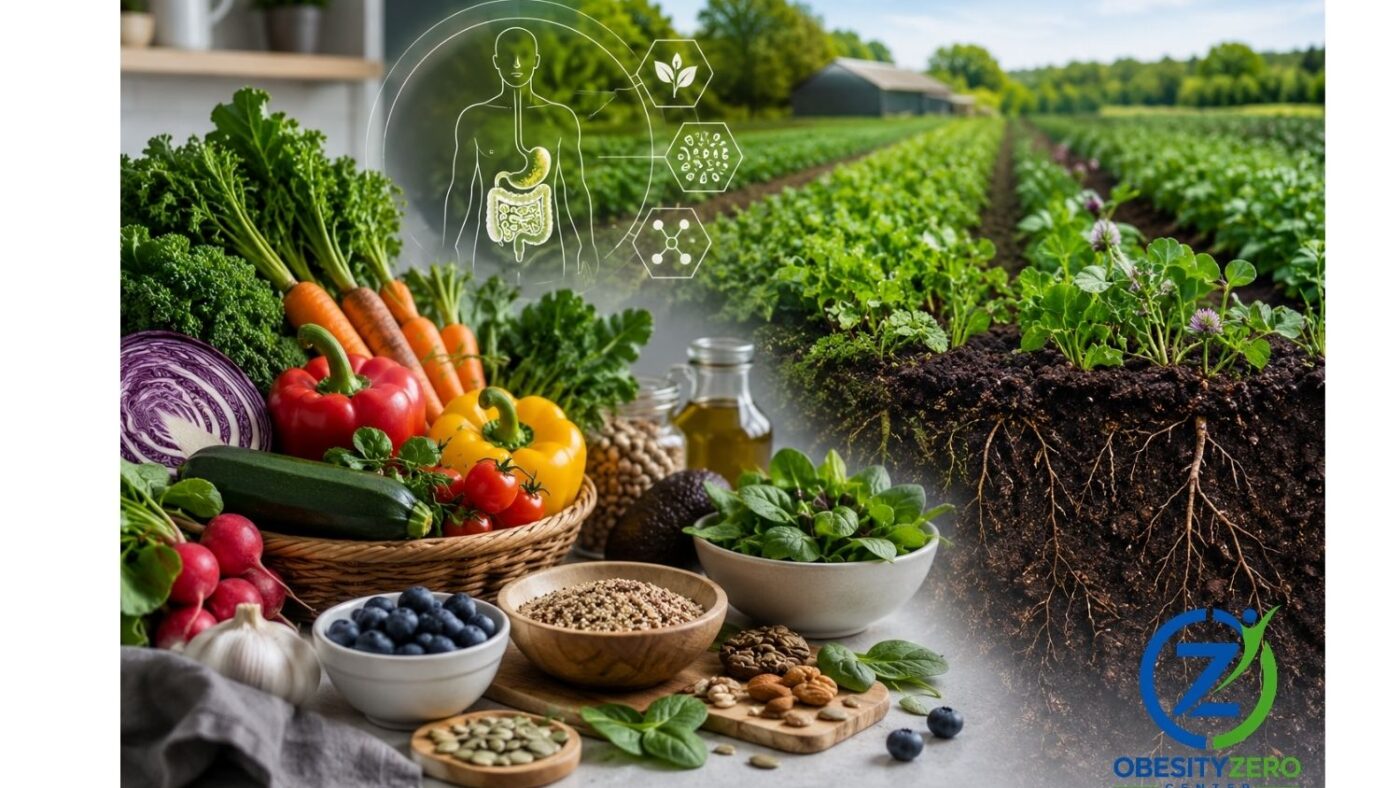
Weight management involves more than counting calories. Food processing, appetite, biology, environment, access, and eating patterns can all influence how much we eat and how our bodies respond. An emerging question is whether the way food is grown, including pesticide exposure and regenerative farming practices, also deserves a place in that conversation.
Why “Eat Less, Move More” Is an Incomplete Story
For years, weight management has often been reduced to a simple instruction: eat less and move more. Energy balance is real, but obesity itself is much more complicated than that slogan suggests.
The World Health Organization describes obesity as a chronic, relapsing disease shaped by complex interactions among genetics, neurobiology, eating behaviors, food access, market forces, the environment, and other social and individual factors. Worldwide adult obesity has more than doubled since 1990.
That means a useful discussion about obesity should include calories, but it should also ask what influences hunger, food choice, energy intake, activity, metabolic health, and the environments in which people live.
This is where Timothy Crouse believes food quality deserves more attention. His concern goes beyond the calorie number on a package. He believes we should also examine how heavily food is processed, what exposures come with modern food production, and whether healthier agricultural systems may ultimately produce healthier food.
What Are “Obesogens”?
The term obesogen is used by researchers for certain environmental chemicals that may interfere with biological processes involved in fat development, appetite, metabolism, or hormonal signaling.
This is a real field of scientific research, but it is also an area where careful wording matters.
Different pesticides have different biological properties. Dose, timing, duration of exposure, age, occupational exposure, and other factors also matter. It would therefore be inaccurate to describe all pesticides, herbicides, or food additives as obesogens.
Glyphosate is a good example of why nuance matters. Laboratory and animal research has raised questions about possible endocrine and microbiome effects. Researchers have also reported associations between glyphosate biomarkers and some metabolic outcomes. Yet human studies remain limited, and they do not establish that typical dietary exposure causes obesity.
The Gut Microbiome Question
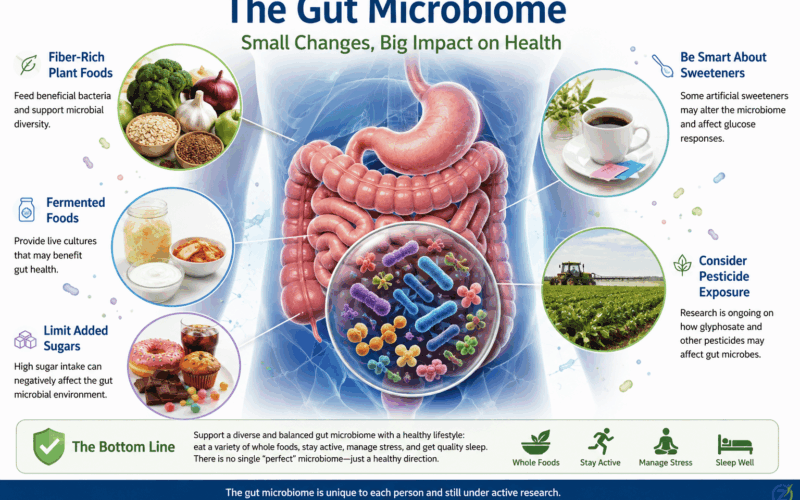
The gut microbiome is involved in many aspects of human biology, including digestion, immune function, production of microbial metabolites, and communication with metabolic pathways.
Because glyphosate targets a biochemical pathway found in plants and many microorganisms, researchers have asked whether exposure could alter gut microbial communities.
Animal and laboratory studies suggest that changes are possible. The much harder question is whether pesticide residues encountered through an ordinary human diet cause microbiome changes large enough to affect health or body weight.
At this point, that has not been established. A 2026 scoping review of human evidence found major gaps in research connecting dietary pesticide residues with gut microbiota and gastrointestinal outcomes. That makes it premature to describe agricultural herbicide residues as “low-grade antibiotics” acting inside the human gut.
What Organic Food Can Clearly Do
One conclusion is much better supported: choosing organic food can reduce exposure to several pesticide residues.
Intervention studies in which people switched from conventional to organic diets have documented substantial reductions in urinary biomarkers for several pesticides. A systematic review and meta-analysis also concluded that organic-food consumption was associated with lower pesticide exposure.
That is a legitimate reason someone may prefer organic food. But exposure reduction should not be confused with proof that organic food prevents or treats obesity.
| Question | What Evidence Supports |
|---|---|
| Does organic food reduce some pesticide exposure? | Yes. Controlled dietary studies have found lower biomarkers for several pesticides. |
| Is organic food pesticide-free? | No. Organic farming restricts most synthetic pesticides, but organic does not mean chemical-free or zero-residue. |
| Is conventional produce unsafe? | Not based on current U.S. monitoring. USDA reported that more than 99% of tested samples in its 2024 program had residues below EPA benchmark levels. |
| Does organic food cause weight loss? | Not established. Observational studies report associations with lower obesity risk, but they cannot prove that organic production is the cause. |
What About Nutrient Density?
There is evidence that farming methods can influence the composition of food, although the size and consistency of those differences remain debated.
A large meta-analysis of organic and conventional crops reported higher concentrations of several antioxidant compounds in organic crops, along with a lower incidence of detectable pesticide residues. Other reviews have found smaller or less clinically meaningful nutritional differences.
So it is reasonable to say that growing practices can influence nutrient and phytochemical profiles. It is not reasonable to say that every organic food is nutritionally superior to every conventionally grown equivalent.
Regenerative Agriculture Is Promising, but the Human-Health Evidence Is Early
Regenerative agriculture generally emphasizes practices intended to build soil health, improve biodiversity, reduce soil disturbance, keep living roots in the ground, and improve ecosystem resilience.
Early research is intriguing. Comparisons of regenerative and conventional farms have found differences in soil health and concentrations of selected vitamins, minerals, and phytochemicals. A broader scoping review also found that certain regenerative practices sometimes increased micronutrient concentrations in particular crops.
But the results varied by crop, farming method, soil, climate, and study design. Researchers concluded that the magnitude and reproducibility of the nutritional effects are still difficult to determine.
Food Processing May Be the More Immediate “Beyond Calories” Issue
One of the strongest pieces of evidence that food quality can influence calorie intake comes from an NIH randomized controlled trial of ultra-processed and minimally processed diets.
Twenty adults lived at the NIH Clinical Center and received diets designed to be similar in presented calories and several major nutrients. When participants were offered the ultra-processed diet, they ate more calories and gained weight. During the minimally processed diet, they ate less and lost weight.
The study does not prove that every food additive is harmful. It does show something important: two eating patterns can look similar on a nutrition spreadsheet while producing different eating behavior when people are allowed to eat as much or as little as they want.
That is an important part of what “beyond calories” should mean.
Practical Ways to Improve Food Quality
- Start with whole and minimally processed foods. Vegetables, fruits, beans, lentils, whole grains, nuts, seeds, eggs, dairy, fish, and other minimally processed foods can form the foundation of a nutritious eating pattern.
- Choose organic when it makes sense for you. Organic food can reduce exposure to several pesticide residues, but do not avoid nutritious conventional produce because organic versions are too expensive or unavailable.
- Wash fresh produce under running water. The FDA recommends thoroughly rinsing produce before preparing or eating it. Soap and commercial produce washes are not recommended.
- Ask farmers how they grow food. At a farmers’ market, you can ask about pesticide use, soil-building practices, crop rotation, cover crops, grazing practices, or organic certification.
- Learn what labels actually mean. Regenerative Organic Certified is one formal standard. Land to Market is an outcomes-based regenerative verification program focused on products sourced from verified land.
- Keep the whole diet in perspective. Whether a carrot is organic or conventional matters less than whether vegetables are regularly part of your eating pattern in the first place.
The Obesity Zero Center Perspective
Obesity is not a personal failure of willpower. It is also not likely to have one environmental, hormonal, agricultural, or nutritional cause.
Timothy’s larger point is worth taking seriously: our food environment has changed, and understanding obesity requires us to look beyond a single number such as calories.
Where Obesity Zero Center draws the line is between a reasonable hypothesis and a proven conclusion.
Organic farming clearly changes how food is produced and can reduce exposure to several pesticide residues. Regenerative agriculture may improve soil health and may influence the nutritional composition of some foods. Environmental chemicals are a legitimate area of metabolic research.
Those facts justify continued research and informed consumer choice. They do not yet prove that organic or regenerative food is an obesity treatment.
For now, the strongest practical approach is to build an eating pattern around nutritious, minimally processed foods, choose organic or regeneratively produced options when they fit your priorities and budget, and remain open to what better research teaches us about the relationship between agriculture, food quality, and metabolic health.
Conclusion: Beyond Calories, Without Abandoning the Science
Calories matter. So do appetite, food structure, processing, genetics, biology, environment, accessibility, and behavior.
The emerging science of environmental exposures may eventually add more pieces to that picture. Organic food already offers one measurable difference: lower exposure to several pesticide residues. Regenerative agriculture offers promising approaches to soil health and potentially food quality.
But evidence-based nutrition requires us to resist replacing one oversimplification with another.
The lesson is not that calories do not matter, or that one farming system can solve obesity. It is that human metabolism exists inside a much larger food system, and understanding that system is part of understanding obesity.
Sources and Further Reading
- World Health Organization: Obesity and overweight
- Systematic review: Endocrine-disrupting pesticides and obesity
- Systematic review and meta-analysis: Organic food and human health
- Scoping review: Pesticide residues, gut microbiota, and human gastrointestinal outcomes
- Preliminary comparison of regenerative farming, soil health, and nutrient density
- Scoping review: Regenerative agricultural approaches and crop micronutrients
- National Institutes of Health: Ultra-processed foods, calorie intake, and weight gain
- USDA 2024 Pesticide Data Program summary
- USDA: Synthetic substances allowed and prohibited in organic crop production