
At OZC, we gather data from many credible medical and scientific sources available to the public…cholesterol has been, for many years, maligned and misunderstood. Plus, our dependency on certain drugs prescribed to us and our relatives to “control” cholesterol levels has to be revisited and understood in order to diminish our dependence on drugs that may be doing more harm than good. Discuss the following with your physician.
For decades, cholesterol has been cast as the ultimate dietary villain, a waxy substance responsible for clogging arteries and causing heart trouble. But if you look closer at human biology, you realize that cholesterol isn’t a villain at all. In fact, it is one of your body’s absolute best friends. Without it, you quite literally could not survive.
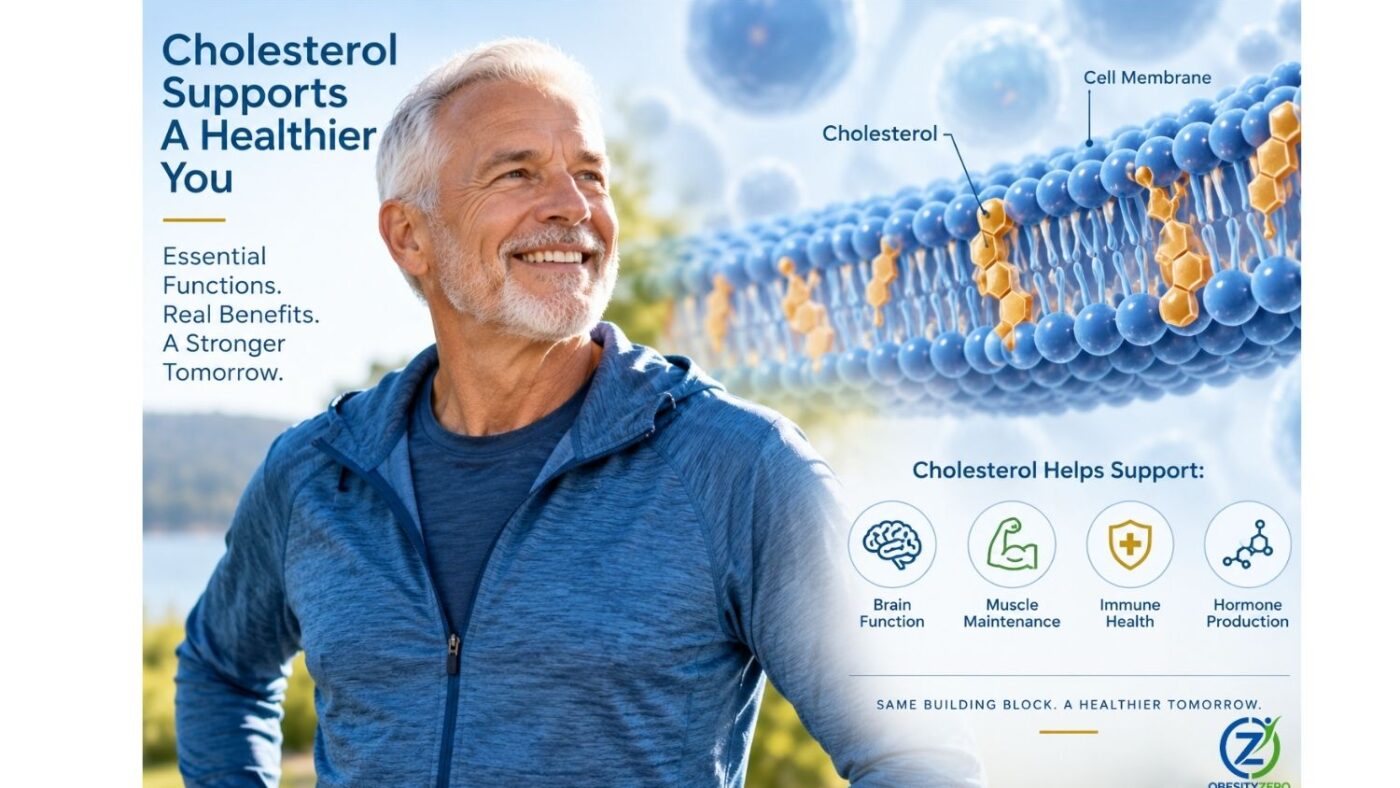
Your body values cholesterol so highly that it doesn’t leave your supply up to chance. Your liver and cells produce roughly 75% to 80% of your body’s cholesterol daily, while only about 20% to 25% comes from the food you eat. It serves as a foundational building block embedded directly into the lipid bilayer (the protective outer shell) of every single cell in your body, providing structural integrity and fluid flexibility.
How Cholesterol Powers Your Systems
1. The Brain’s Best Friend
While the brain makes up only about 2% of your body weight, it contains a massive 25% of the body’s total cholesterol. It is a major component of the myelin sheath, the fatty insulation wrapped around nerve fibers that allows electrical signals to travel rapidly. Without adequate cholesterol, synapse formation and cognitive function drop significantly, leading to issues with memory and focus.
2. Muscle Maintenance and Repair
Muscles require structural resilience to withstand the stress of exercise and daily movement. Cholesterol stabilizes muscle cell membranes, protecting them from tearing under strain and aiding in their post-workout repair. Furthermore, low cholesterol levels are frequently linked to muscle pain and weakness, as cells struggle to maintain their physical integrity.
3. The Immune System’s Shield
Cholesterol plays an active role in neutralizing toxins. Lipoproteins (the packages like LDL and HDL that carry cholesterol through the blood) actually bind to and deactivate harmful bacterial endotoxins. When your body fights an infection, your immune cells rely heavily on cholesterol to build up their defenses and communicate effectively with one another.
4. The Master Key for Hormones
Cholesterol is the literal chemical precursor, the raw material, for all steroidal hormones. Without it, your body cannot manufacture:
- Sex hormones: Testosterone, estrogen, and progesterone.
- Stress adaptors: Cortisol (which manages inflammation and energy usage).
- Vitamin D: Technically a hormone synthesized from cholesterol in your skin when exposed to sunlight, crucial for bone health and immune regulation.
The Upward and Downward Shift
Your body actively regulates cholesterol levels based on systemic needs, systemic damage, and dietary inputs.
- What Drives Levels Upward? Because cholesterol acts as a cellular band-aid and building block, your liver will pump out more cholesterol when there is systemic inflammation, high stress (requiring more cortisol), or vascular damage. Diets high in refined sugars and industrial seed oils trigger inflammation, causing cholesterol numbers to rise as the body tries to repair the damage.
- What Drives Levels Downward? A healthy, low-inflammation environment tells the liver it can ease up on production. Levels also drop when your body efficiently uses cholesterol to synthesize bile acids (for digestion) or hormones.
Achieving Healthy Levels: Natural vs. Pharmaceutical Approaches
When dealing with high cholesterol, the conventional approach often leans immediately toward pharmaceuticals, but understanding the difference between standard medicine and lifestyle changes is crucial for finding the right balance.
Natural Approaches
Achieving healthy cholesterol levels naturally isn’t about avoiding cholesterol in food; it’s about reducing systemic inflammation so your liver doesn’t feel forced to overproduce it.
- Reduce Inflammatory Triggers: Swapping out refined sugars, processed carbs, and industrial vegetable oils for whole foods naturally normalizes the body’s repair signal.
- Incorporate Healthy Fats: Enjoying extra virgin olive oil, avocados, wild-caught fish, and grass-fed butter provides the high-quality fats your body uses to optimize HDL (“good” cholesterol) and improve particle sizes.
- Regular Strength and Cardio Exercise: Physical activity actively prompts the body to move cholesterol more efficiently, raising protective HDL levels and improving cardiovascular resilience.
- Manage Chronic Stress: Lowering stress directly lowers the demand for cortisol, reducing the liver’s need to pump out extra cholesterol building blocks.
Ultimately, cholesterol isn’t an enemy to be driven down to the lowest possible number. It is a vital asset that your body produces out of sheer necessity. By focusing on overall metabolic health and reducing inflammation, you allow this natural “best friend” to do its job safely and effectively.